Field note · mathematics
Perfect Squares Between Consecutive Blocks
Geometry and number theory are a natural pairing because integers can be studied not only as symbols, but also as structured objects with position, symmetry, and factor behavior. Perfect squares provide a natural meeting point between geometry and number theory because they turn integers into geometric objects. Side lengths are integers, square areas are integers, and the passage from one square to the next produces a structured sequence of integer outputs.
Number theory enters naturally once integers are viewed in this geometric way. Geometric structure helps organize the setting, and number-theoretic ideas help decode that structure.
Consecutive Square Blocks
The two plots below illustrate that idea.
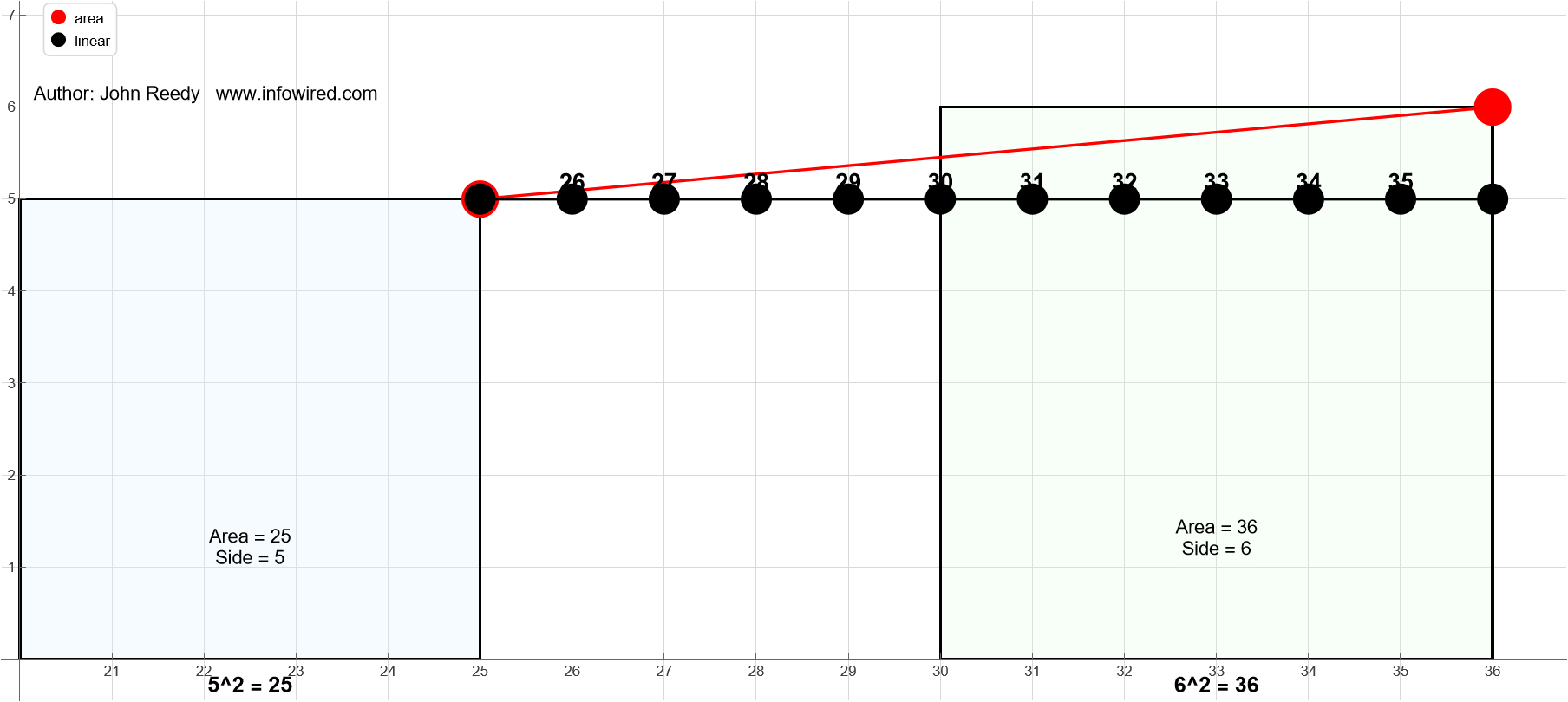
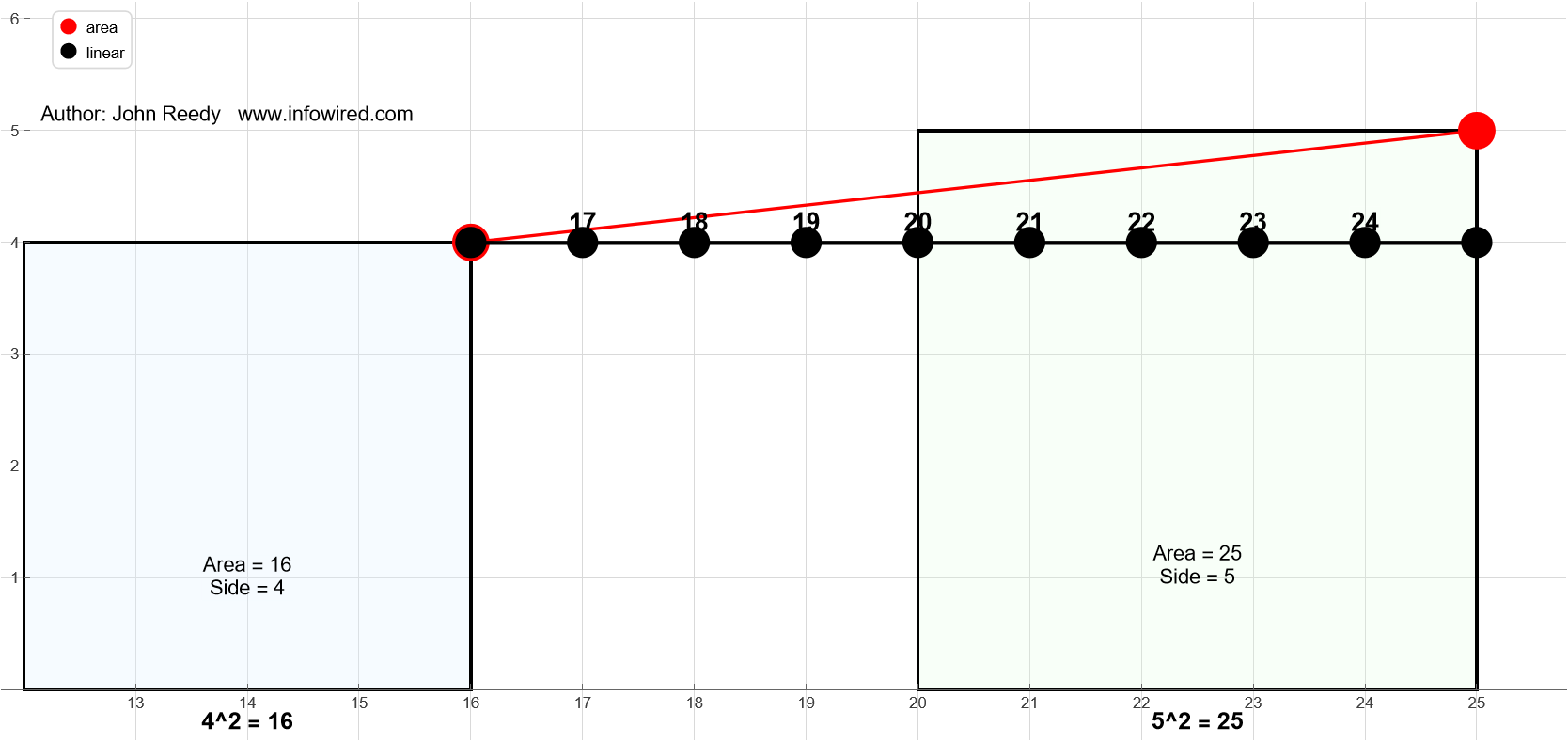
These plots show how integers sit between consecutive perfect squares. In the first plot, the numbers from 16 to 24 lie in the interval between 4^2 = 16 and 5^2 = 25. In the second plot, the numbers from 25 to 35 lie in the interval between 5^2 = 25 and 6^2 = 36.
Perfect squares act like anchor points, and the integers between them form a natural block from one square to the next.
Plot: From 4^2 to 5^2
Plot: From 5^2 to 6^2